
AI Agent Sprawl in Trucking: What Carriers Pay When Every System Vendor Sells Its Own AI
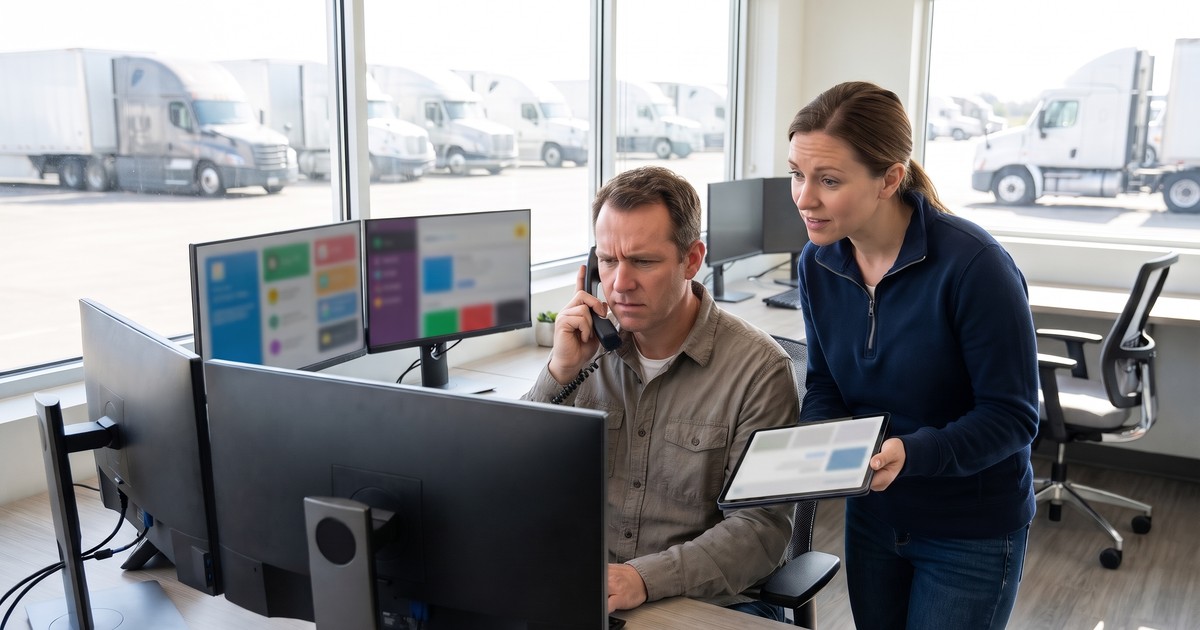
Your vendors are all shipping their own AI at the same time. Dispatch, maintenance, and driver hiring each arrive with an agent attached. Those agents cannot see what the other systems just did. One AI workforce can read across them, answer once, and write the result back.
What is AI agent sprawl in trucking?
AI agent sprawl in trucking is a crowd of AI agents from different vendors, each working inside one system and managed on its own.
In a carrier it shows up as one agent for the dispatch system, one for the warehouse, one for maintenance, one for driver hiring, and one for billing. Each agent has its own contract, its own setup, and its own view of the company. The cost is repeated spend with no shared scale. Handoffs break between systems. Drivers and shippers get conflicting answers. Each system keeps its own record of the load. More agents mean more access to review. When a miss crosses systems, nobody owns it.
One AI workforce is the other path. It is set up once across the systems the carrier already runs. It keeps one memory of the load, the truck, and the customer. It uses one voice. It hands off to people when it is not sure. It writes the result back into each system. The dispatch system stays in place. So do the warehouse system, the maintenance system, the hiring system, and billing.
How does AI show up inside software you already pay for?
The agents show up inside software the company already pays for. A fleet on common tools could reach early 2027 with agents from several of those vendors. That is a reading of product announcements. This page found no trucking survey of AI vendors per fleet.
The pattern shows up in the systems a carrier already runs.
- One dispatch vendor ships its own agents. Each agent is set up on its own.
- Some point tools in the cab call or message drivers. Some include those agents in the plan the fleet already pays for.
- A maintenance system adds an advisor that drafts work orders.
- A hiring system adds voice outreach to candidates.
- The meters do not match. One bills by use. One sells a block of time, then extra. One folds the agent into the subscription. One sells premium actions on the side.
Some vendors ask you to define what each agent knows, what it can do, and when it needs a person. Multiply that by every system on the yard.
One agent inside one vendor's products still sees only that vendor's slice. Maintenance, hiring, and billing often come from other companies. The carrier can still end up with a crowd.
Billing still sits in the sprawl problem. An invoice hold lives outside the dispatch agent.
What breaks when a driver calls about a late load?
This walkthrough is a scenario. It names no customer.
- A driver calls about a late load.
- The dispatch agent reads the dispatch system and gives an ETA.
- The maintenance system has an open repair on that truck. The dispatch agent does not see it.
- Billing is holding the customer's invoice. The dispatch agent does not see that either.
- The shipper hears one story. The driver hears another.
- A second agent calls the driver again about the same load.
- A person copies the facts from screen to screen and fixes the mess by hand.
The exception lives in the gap. A breakdown touches dispatch, the shop, the customer, and billing. An OS&D touches the load record, warehouse receiving, the claim, and the invoice. An agent that can see only one system can finish its own screen and still leave the job undone.
The same call with one AI workforce is a different day.
- The driver calls about the late load.
- The AI workforce checks the dispatch system, the maintenance system, and billing in one pass.
- The driver and the shipper get one answer. It includes the ETA, the open repair, and the invoice hold.
- The result is written back into each system that the decision touched.
- The people who own the exception are alerted.
- If the AI workforce is not sure, it hands the call to a person before the miss.
OS&D is one place that gap shows up in production work. Breakdown intake is another. Check calls are a third.
What does the carrier pay when every vendor brings an agent?
There is no economy of scale. Cost, effort, upkeep, and cyber risk repeat once per system.
The meters do not match. One vendor bills by use. Another sells a block of time, then charges extra. Another includes the agent in the subscription. Another sells premium actions as add-ons.
Setup repeats too. Each agent has to learn the carrier's rules, customers, exceptions, and escalation paths. What the maintenance agent learns about a shop delay never reaches the dispatch agent. The lesson is paid for once per system and shared with none.
Upkeep repeats as well. Each agent needs its own review when a rule, a customer, or a model changes.
Building the system of record is one specialty. Running AI safely, at scale, is another. Each specialty stays with the people who practice it. Trust the AI specialists who have already been integrated with your systems for years.
The AI workforce page publishes "Flat, fixed pricing per agent" and "no per-minute or per-call meter that spikes in your busiest months." That is one vendor and one way of pricing. Each agent is still its own price. The gain is one setup, one memory, and one place to review the work.
Use this list on your own vendor stack. The list is questions only.
- How many AI contracts are you signing, including agents that arrived inside software you already pay for?
- How many separate setups will teach your rules, your customers, and your escalation paths?
- How many agents can call or message your drivers?
- How many products log an action on one load?
- How many new logins, keys, and system connections come with each agent?
- Who do you call when a miss crosses systems and each vendor shows that its agent did its part?
Why do drivers and shippers hear more than one company?
Separate agents can call the same driver about the same load for different reasons. The shipper can hear a different fact than the driver. Each agent follows its own script. To the driver, every call is still the carrier.
One AI workforce can hold one tone. The breakdown case study for a Top 5 U.S. Truckload Carrier lists "Calm tone built for accents, fragmented speech, and loud road noise." The freight operations case study lists "Consistent: Accuracy across all carrier interactions." That is one tone on the calls those studies cover.
Who keeps the record, the access, and the blame?
Each agent logs its work inside its own product. Rebuilding one load means pulling logs from several vendors.
Gartner, on Apr 28, 2026, said only 13% of organizations think they have the right AI agent governance. The same release said a Fortune 500 enterprise will have over 150,000 agents by 2028, up from fewer than 15 in 2025. Gartner named the risks as "misinformation, oversharing and data loss." These figures are enterprise predictions, not trucking counts.
Salesforce, on Feb 5, 2026, surveyed 1,050 IT leaders at companies with 1,000 or more employees. It is an enterprise survey, not a trucking study. Half of the agents sit in isolated silos. The report said 86% of IT leaders worry that agents add more complexity than value without integration. It said 54% have a centralized governance framework.
Every extra vendor needs its own access into carrier data. More agents mean more places for data to leak. Gartner says that through 2028 more than 50% of AI initiatives will halt "because of unresolved agentic identity challenges." That page is undated. The figure is an enterprise prediction.
When a load goes wrong across three vendors, each one can show that its agent did its part. The carrier owns the outcome. Gartner says agents "are not legal entities and cannot be held responsible for the consequences of those actions."
Moneiva writes the result back into the systems already in use. On AI Operator, the dispatch system stays the system of record. A person can correct a single situation. The page says, "The change is reviewable and reversible."
Why does the manual work stay?
Siloed agents move the work. Staff still copy facts between systems and chase the gap. People become the glue.
The Salesforce survey above is the enterprise version of that complaint. Half of the agents sit in silos. Most of those IT leaders worry about complexity. The survey covers enterprise IT.
The homepage says "It sits above your systems, not beside them" and "Moneiva isn't one more screen for your team to check." The homepage demonstration, not a case study, updates four systems on one OS&D exception and ends with "Four systems updated, no dispatcher or AR clerk touching a single screen."
The freight operations case study reports "1,000s Of loads processed weekly without manual touchpoints" and "No Headcount: Operations scaled without adding staff." Operations lists driver recruiting and billing among the jobs Moneiva runs. The published case studies cover breakdown intake, maintenance scheduling, and the freight lifecycle. They do not publish numbers for driver hiring or for billing.
Frequently asked questions
What is AI agent sprawl in trucking and logistics? AI agent sprawl in trucking is a crowd of AI agents from different vendors, each working inside one system and managed on its own. In a carrier it shows up as one agent for dispatch, the warehouse, maintenance, driver hiring, and billing. One AI workforce is set up once across the systems already in use, with one memory, one voice, a handoff to people, and a write-back to each system. The dispatch system stays the system of record.
Should a carrier buy an AI agent from each software vendor it already uses? Each purchase repeats the contract, the setup, the upkeep, and the vendor review. The agents cannot see what the other systems did. Ask for one AI workforce across the systems the carrier already runs.
What goes wrong when dispatch, maintenance, driver hiring, and billing each have their own AI agent? A late load is the short version. The dispatch agent gives an ETA. It misses an open repair and an invoice hold. The driver and the shipper hear different facts. Another agent calls the driver again. A person copies the facts across screens. Hiring and billing agents add more voices and more logs. Published case studies do not cover those two jobs with numbers.
Why do separate AI agents give drivers and shippers conflicting answers? Each agent sees one system and follows that vendor's script. The dispatch agent does not know what maintenance or billing just did. The driver can get a second call from a different agent about the same load.
What does it cost to run AI from several vendors? The carrier repeats contracts, setup, upkeep, connections, access reviews, and vendor management. The meters do not match. One bills by use. One sells a block of time, then extra. One includes the agent in the subscription. One sells premium actions as add-ons. This page found no published trucking figure for integration cost per carrier.
Who is accountable when an agent in one system acts on stale facts from another? The carrier owns that outcome. Gartner says agents "are not legal entities and cannot be held responsible for the consequences of those actions." Each vendor can show that its own agent did its part.
Does every added AI vendor widen the cyber risk? Each added vendor brings another login, another key, and another path into your systems. Ask who can reach your data, how that access is removed, and who you call if something leaks.
Can your data leak into a model provider's training data? Ask the vendor whether your loads, calls, and customer records can be used to train a general model. Ask where that data sits, who else can see it, and how you turn that use off.
With so many models available, how do you know which model to use? A voice call, a document read, and a write-back are different jobs. Ask who chooses the model for each job, who retests it when a new model ships, and who owns the result when the model changes.
Where should I start? Start with the agents your vendors are already selling you. Pick one high-volume job that crosses your systems. Breakdown intake, OS&D, and check calls are the published places to start. Run that job as a pilot on your own data. The AI workforce page uses the phrase "Live in weeks."
List the AI agents your vendors are already pitching. Pick one high-volume job that crosses systems, such as breakdown intake, OS&D, or check calls. Run it as a pilot on your own data. See the AI workforce, estimate the return, or book a demo.